
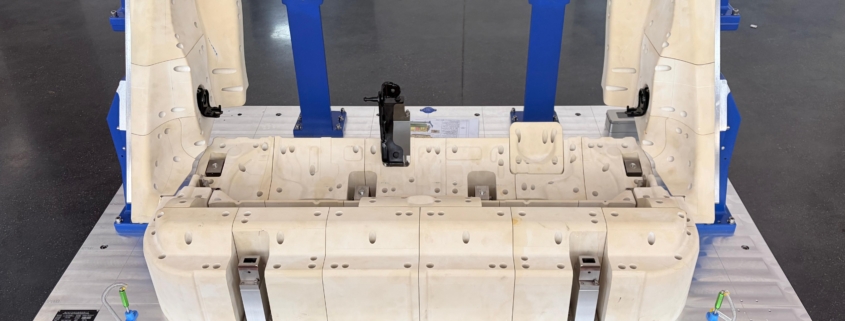
Amidst the fierce, cutthroat competition and rapid industrial upgrading characterizing the manufacturing sector, the inspection fixture industry—which serves as the benchmark for precision manufacturing quality—finds itself caught in a tug-of-war between commoditized competition and the imperative to move up the value chain. Companies in this sector face the dual challenge of absorbing rising costs for raw materials, labor, and R&D while simultaneously meeting the rigorous demands of downstream industries—such as new energy vehicles, aerospace, and high-end electronics—for ultra-precise tolerances, short delivery cycles, and intelligent inspection capabilities. Low-price bidding, the proliferation of generic knock-offs, and an oversupply of low-end capacity epitomize the industry’s hyper-competitive stagnation; however, the emergence of “new quality productive forces” points the way forward, offering a path for companies to break free from the shackles of price wars and rebuild their competitive moats through precision-driven innovation.
New Quality Productive Forces and the Transformation of the Check Fixture Manufacturing Industry
The core essence of “new quality productive forces” lies in driving industrial quality improvement and efficiency gains through cutting-edge technologies, digital empowerment, specialized talent, and full-chain collaboration. This approach marks a decisive shift away from extensive growth and price-based competition toward competition based on technological value—a development logic that aligns perfectly with the inspection tooling industry as it navigates a critical period of transformation.
For the precision check fixture manufacturing industry, the implementation of new quality productive forces rests on three core pillars: first, highly skilled talent dedicated to R&D and technical implementation in areas such as precision measurement, mold matching, and intelligent inspection; second, advanced technologies and core equipment, including high-precision machining tools, 3D simulation design, and AI-driven inspection systems; and third, a digital collaborative innovation system spanning the entire value chain—from design, machining, and debugging to delivery and after-sales service—drives the industry’s transformation and upgrade from contract manufacturing to precision intelligent manufacturing and technical services.
Key Characteristics and Challenges of the Current Check Fixture Manufacturing Industry
The Core Conflict: Cutthroat Price Competition vs. the Need for Higher Precision
The domestic check fixture manufacturing industry is characterized by low concentration and a vast number of small and medium-sized enterprises; there is severe overcapacity in low-end, general-purpose fixtures, and the industry is generally trapped in a vicious cycle of cutthroat price competition. Data shows that transaction prices for mainstream automotive component inspection tools have dropped by nearly 50% over the past decade, while costs for raw materials—such as aluminum alloys, precision steel, and high-end sensors—and labor for precision machining have continued to rise. Simultaneously, requirements from downstream OEMs and high-end manufacturing clients have escalated significantly, shifting from traditional dimensional inspection to micron-level tolerance control, surface-matching precision, comprehensive geometric dimensioning and tolerancing (GD&T), and zero-deviation fitment. This dual pressure—rising costs coupled with demands for higher precision—has rendered traditional profitability models completely obsolete.
Dual Pressures: Technological Iteration and Delivery Efficiency
Rapid iteration in downstream industries is compelling the inspection fixture sector to accelerate its upgrading. The widespread adoption of integrated die-cast components for new energy vehicles, complex structural parts, and precision aerospace components has triggered a surge in demand for non-standard, customized inspection fixtures. As product development cycles shorten significantly, customers are demanding greater efficiency in fixture design, manufacturing delivery, and on-site commissioning. This forces enterprises to move beyond mere high-precision manufacturing and achieve rapid R&D and implementation. However, many small and medium-sized fixture enterprises—reliant on traditional 2D design, manual commissioning, and experience-based machining—struggle to meet market demands for high precision and rapid iteration.
Industry Imperatives: Intelligent Inspection and End-to-End Traceability
As quality control systems in modern manufacturing become increasingly sophisticated, leading downstream clients are no longer satisfied with basic inspection functions; they now require fixtures capable of automated inspection, real-time data acquisition, end-to-end quality traceability, and intelligent data analysis. Traditional mechanical and manual fixtures—characterized by limited functionality, an inability to retain data, and low inspection efficiency—fail to meet the operational requirements of intelligent manufacturing production lines. Furthermore, a shortage of high-level technical talent, a gap in process expertise, and a lack of standardized systems have rendered traditional, rudimentary models of design, manufacturing, and quality control unsustainable.
Operational Challenges in High-Mix, Low-Volume Production
The market share of non-standard, customized orders is steadily rising, making high-mix, low-volume, and personalized production the mainstream model. Frequent design iterations, process adjustments, and equipment recalibrations significantly increase the risk of machining errors and production costs. Traditional inspection tool manufacturers, lacking standardized and modular systems, are highly susceptible to issues such as inconsistent precision, fluctuating yield rates, and delivery delays—further exacerbating their competitive disadvantage in the industry.
Key Pain Points in Precision Iteration for the Inspection Tooling Industry
Reactive Precision Control and High Reliance on Manual Labor
Precision management at many traditional check fixture manufacturing companies relies on the experience of veteran craftsmen, lacking a standardized parameter system across the design, machining, and debugging processes. Methods involving manual measurement and calibration are highly prone to human error; precision deviations often go undetected until the final debugging or customer acceptance stages, leading to rework, batch rectifications, significant profit loss, and delivery delays.
Prominent Data Silos and Difficulty in Preserving Technical Expertise
Data fragmentation is widespread across the industry; design parameters, machining processes, debugging data, and customer rectification plans are stored disparately, preventing the interconnection of equipment, process, and quality data. Without systematic precision and technical knowledge databases, companies cannot reuse best practices or trace the root causes of errors. This results in long training cycles for new staff, a risk of losing core technical expertise, and an inability to build sustained capabilities for precision iteration.
Severe Homogenization and Shortcomings in High-End Technology
Imitation is rampant in the low-end check fixture market, with products exhibiting highly similar structures, designs, and inspection functions, forcing companies to compete primarily on price. Conversely, in sectors such as high-end intelligent check fixtures, automated in-line inspection fixtures, and micron-level precision fixtures, domestic companies lack core technical reserves. Shortcomings persist in areas like high-end sensors, intelligent algorithms, and precision calibration technology; the high-end market remains dominated by overseas brands, and the process of domestic substitution is slow.
Insufficient Flexibility and Lagging Adaptability
To meet the diverse and customized inspection requirements of downstream clients, most enterprises lack flexible design and production capabilities and possess immature modular systems. They lack the capacity to design and develop inspection tools for irregularly shaped parts, large integrated components, and ultra-high-precision parts; consequently, they cannot rapidly respond to specific precision requirements, resulting in weak market adaptability.
Strategies for Advancing Precision and Systemic Upgrades
Leveraging Digital Simulation for Proactive Precision and Quality Control
By utilizing 3D CAD modeling and tolerance simulation analysis, companies can conduct proactive verification during the inspection tool design phase. Simulating component fit, potential inspection error ranges, and deformation risks at the early design stage allows for the optimization of structural plans and the calibration of tolerance parameters. This approach mitigates design flaws at the source, significantly boosting the first-time design pass rate and the first-time processing rates for both design and manufacturing, while reducing costs associated with trial assembly and rework. Furthermore, digital simulation technology shortens the design and R&D cycle, enabling the company to meet client demands for rapid delivery.
AI Empowerment for Dynamic Precision Optimization
An AI-driven parameter optimization system is implemented to intelligently analyze data across the entire lifecycle of checking fixture processing, calibration, and inspection, dynamically optimizing manufacturing processes, calibration parameters, and inspection benchmarks. Intelligent visual inspection and high-precision scanning technologies replace traditional manual methods, enabling 100% inspection of finished fixtures. This allows for the precise detection of micron-level deviations, rapid error feedback, and accurate corrective actions, thereby continuously enhancing the stability of fixture precision.
End-to-End Systems for Full-Process Precision Traceability
A digital management system tailored to the check fixture manufacturing industry is established, integrating data flows across design, manufacturing, commissioning, delivery, and after-sales service. A library of precision defect patterns and a root-cause analysis system are created to archive data on every precision deviation, corrective action, and process optimization. This enables full-lifecycle precision traceability—from raw material selection and component machining to finished-product calibration and on-site customer commissioning—facilitating closed-loop issue management and continuous process precision improvement.
Talent Empowerment and Knowledge Capitalization to Solidify the Foundation of Precision
A specialized talent development system is established to cultivate highly skilled technical personnel, focusing on the core areas of precision design, precision machining, and intelligent inspection. AR-assisted work instructions are introduced to standardize machining, commissioning, and calibration workflows, thereby reducing the likelihood of human error. Comprehensive process knowledge bases and precision standard libraries are created to capture the company’s core process expertise; this shortens training cycles for new employees, standardizes technical experience for reuse, and continuously strengthens precision manufacturing capabilities.
Modular and Flexible Upgrades to Enhance Market Resilience
Implement modular, standardized, and serialized design patterns for check fixture, unifying basic structures, mounting references, and calibration standards while adapting modules to meet specific customer needs. Establish flexible production lines and optimize rapid changeover and commissioning processes to effectively address the challenges of high-mix, low-volume production. This approach boosts efficiency and shortens delivery times while maintaining ultra-high precision, balancing customization requirements with the quality advantages of mass production.
New Industry Trends: From Passive Adaptation to Active Leadership and Reconstructed Competitive Barriers
From Reactive Rectification to Predictive Precision Maintenance
The industry will move away from the traditional “reactive rectification” quality model toward predictive precision control. By establishing databases for equipment precision, calibration logs, and wear monitoring systems, companies can monitor the entire lifecycle of processing equipment, inspection tooling, and finished inspection gauges. This enables the anticipation of precision degradation and equipment wear risks, facilitating proactive calibration and maintenance to ensure consistent product precision.
Upstream Customer Collaboration to Deeply Align with End-User Needs
Check fixture manufacturers will increasingly participate in the early stages of customer product R&D—engaging during component design and process validation—to optimize overall check fixture solutions based on testing standards and precision requirements. Through collaborative development, manufacturers can ensure a high degree of alignment between check fixtures and end products, enhancing the professionalism and feasibility of their solutions, and evolving from simple product suppliers into providers of comprehensive precision fixture solutions.
Collaborative Innovation Across the Supply Chain to Break Through High-End Technology Bottlenecks
Foster collaborative innovation by partnering with raw material suppliers, precision equipment manufacturers, and research institutions. Focus on overcoming critical technical shortcomings—such as high-end sensors, intelligent inspection algorithms, and ultra-high-precision machining processes. Supply chain collaboration helps bridge technological gaps in high-end check fixtures, accelerates domestic substitution, and enables companies to break free from cutthroat competition in the low-end market.
Lean Precision Management Across the Entire Process to Establish a Value-Based Competitive Philosophy
The industry will widely adopt lean precision management, establishing a business philosophy where “precision deviation equals profit loss” and “technological upgrades equal core value creation.” By rejecting the mindset of low-price competition, companies can build differentiated competitive advantages through stable micron-level precision, zero-defect delivery, intelligent inspection services, and rapid delivery capabilities.
Conclusion: Breaking the Cycle of Cutthroat Competition through Precision-Driven Evolution
In an era of hyper-competition and “involution” within the manufacturing sector, the era of low-price, commoditized competition in the check fixture manufacturing industry has reached its limit. As the “yardstick” for manufacturing precision, an check fixture company’s core competitiveness lies not in price-cutting, but in exceptional precision stability, continuous technological evolution, efficient delivery and service capabilities, and deep-rooted technical expertise.
By moving away from crude expansion and destructive price wars—and guided by “new quality productive forces”—companies must pursue comprehensive upgrades in digitalization, intelligence, flexibility, and collaboration. The path forward involves relentlessly advancing precision capabilities, consolidating core technologies, and refining lean management systems. Transforming precision advantages into an irreplaceable competitive barrier allows companies to break out of the “red ocean” of low-end price competition and enter the “blue ocean” of value-driven technological innovation. This fosters high-quality, sustainable, and long-term growth, laying a solid foundation of precision for the upgrading and quality enhancement of high-end manufacturing.